
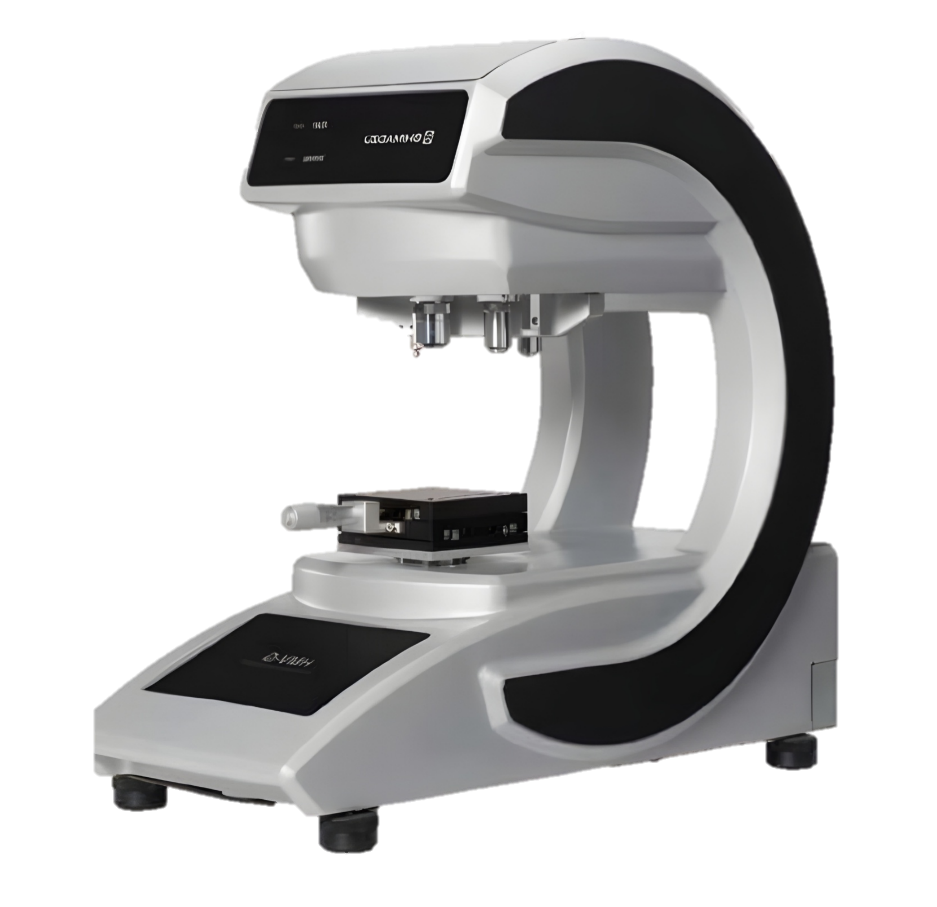
Brand
SHIMADZU
Description
The Micro Vickers Hardness Tester HMV-G is a laboratory instrument used to measure the hardness of materials on a very small scale, typically for fine or small samples, thin coatings, and microstructures. It’s an advanced version of the Vickers hardness test, offering high precision, and it’s commonly used in materials science, metallurgy, and microelectronics.
OPRATING PRINCIPLE
- A diamond indenter with a pyramidal shape (the Vickers shape) is pressed into the surface of the material. The test is typically carried out using loads ranging from 1 g to 1,000 g (or higher), depending on the application and material.
- The tester applies a specific load for a set duration (usually 10 to 15 seconds) to create an indentation. The load is then removed, and the indentation is measured using high-precision optical systems. The size of the diagonal of the indentation is measured under a microscope or through an optical system. The Vickers Hardness Number (VHN) is calculated using the formula:
RESULTES
The Vickers Hardness Number (VHN) is a dimensionless number that represents the hardness of the material. A higher VHN indicates a harder material. The result is usually given in kgf/mm² (kilogram-force per square millimeter), but it can also be converted into other hardness units.
KEY FEATURES
- Flexible Load Range: Can apply loads from 1g to 1000g, making it versatile for different materials.
- Diamond Indenter: Uses a sharp diamond pyramid indenter for precise indentations.
- Microscopic Measurement: Measures indentation size under a microscope for accurate results.
- Multiple Test Modes: Offers different testing modes for diverse materials and requirements.
- Data Analysis Software: Integrated software calculates hardness and generates reports.
- High Throughput: Automated systems speed up testing for large batches.
ADVANTAGES
- High Precision: Measures hardness at a microscopic scale, ideal for small or fine materials.
- Small Indentation Sizes: Creates tiny indentations (micron scale), preserving material integrity.
- Wide Material Range: Can test metals, ceramics, composites, thin films, and polymers.
- Low Load Capability: Suitable for fragile materials, applying very light loads (as low as 1g).
- Localized Measurement: Offers detailed hardness readings at specific locations, like grain boundaries or microstructures.
- Minimal Sample Prep: Requires little to no sample preparation, saving time.
- Automated Systems: Many models include automated measurement, improving consistency and efficiency.
APPLICATIONS
- Material Science: Measuring the hardness of small samples, fine powders, and coatings, such as for metals, ceramics, composites, or polymers.
- Thin Film Coatings: Evaluating the hardness of thin films or coatings used in electronics or machinery.
- Microstructure Analysis: Studying the hardness variation across microstructures or along grain boundaries in metals or alloys.
- Quality Control: For industries like automotive or aerospace, where precise material properties are critical.
Failure Analysis: Understanding the wear resistance or mechanical properties of materials that have been subject to stress or failure